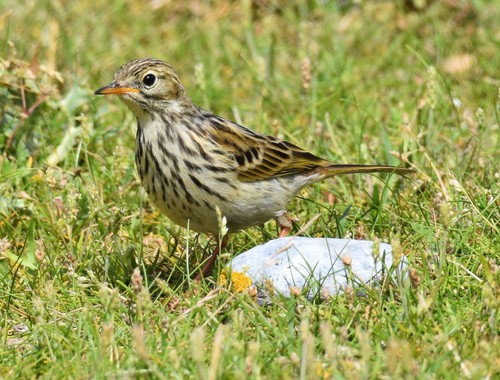
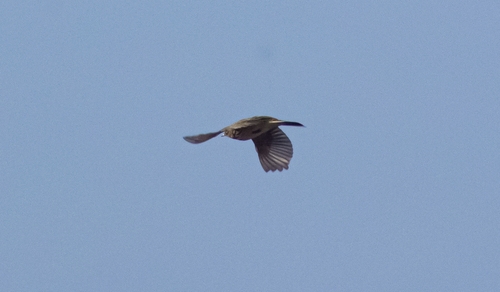
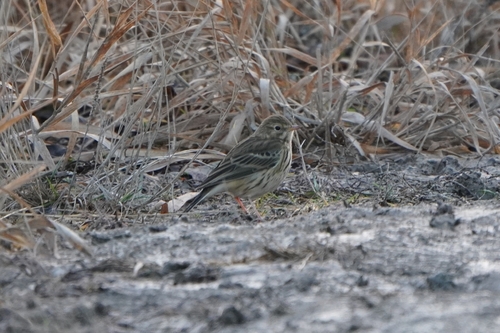
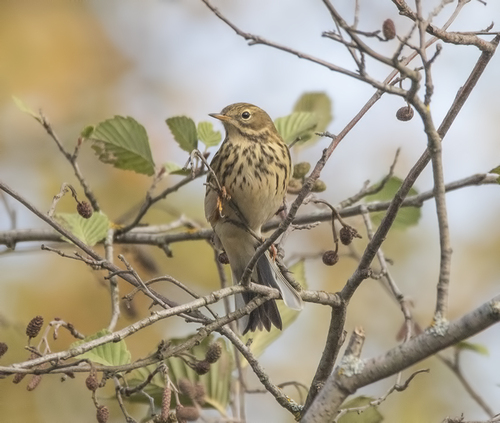
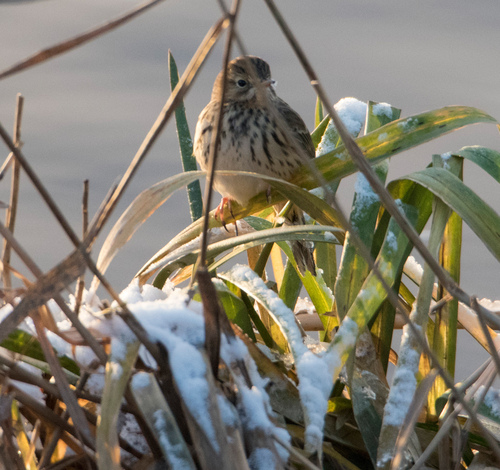
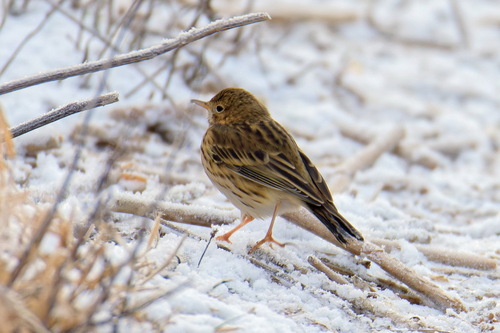
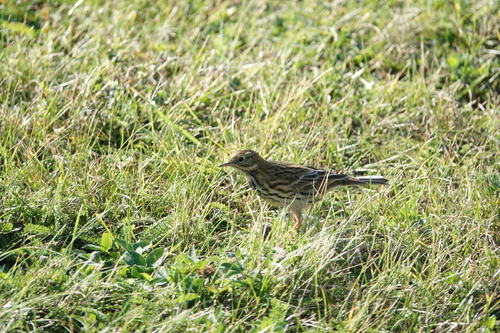
Anthus pratensis (Linnaeus, 1758)
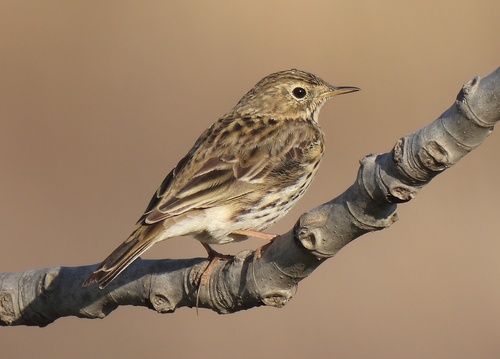
Source: Wikipedia
- 3,382,683 GBIF occurrences
- 35,079 iNaturalist observations
In Europe, the breeding population is estimated to number 11,000,000-14,900,000 pairs, which equates to approximately 22,000,000-30,000,000 mature individuals and 33,000,000-45,000,000 individuals (BirdLife International in prep.). Europe forms 90% of the global range, so a very preliminary estimate of the global population size is 24,000,000-33,000,000 mature individuals and 37,000,000-50,000,000 individuals although further validation of this estimate is needed.
This species breeds in a wide range of open habitats, such as tundra, moorland and heathland, bogs, saltmarshes, dunes, coastal meadows, hillsides, forest clearings, fallow land and occasionally in arable land. Powolny et al., (2018) showed meadow pipits have a preference for alfalfa and grassland, but avoid winter cereal fields. In the winter it is also found along seashores. The species is mainly resident or a partial migrant in western Europe. Birds from Greenland and Iceland migrate to western Europe. Northern and eastern populations are generally medium-distance migrants (Tyler et al., 2020). There are apparent associations of meadow pipits with high elevations, cool slopes and wet locations (Massimino et al., 2020), which may be due to the ecology of their prey, whose abundance is positively correlated with soil moisture and negatively with summer temperature (Pearce-Higgins, 2010). Fine-scale variation in topography, measured by relative elevation, solar index and topographic wetness explains about a third of the variation in the probability of meadow pipit occurrence at fine scale. It breeds from late March to August. The nest is a neat cup of grass, lined with finer grass and hair and is concealed amongst vegetation on the ground. Clutches range from two to seven eggs and clutch size increases with latitude (Tyler et al., 2020). It feeds mainly on invertebrates but does consume some plant seeds in the autumn and winter (Snow and Perrins, 1998). Population density of the Meadow Pipit is positively associated with Common Crane abundance, probably related to a protective effect against nest predators (Fraixedas et al., 2020).
The main cause of declines is thought to be agricultural intensification (Tyler et al., 2020; L. Raudonikis in litt., 2015). It is suggested that extirpation of insects is detrimental for insectivorous birds, such as the meadow pipit (Csiki et al., 2020). Douglas et al., (2020) has shown that the replacement of open-ground through woodland expansion could cause declines in meadow pipit abundance; for example, the creation of 55 square kilometres of native woodland in Scotland across 2017-18 predicts reduced meadow pipit abundance of 0.13% of the current UK population. The loss of short-grass meadow habitats has contributed to declines in the abundance and AOO of this species in European Russia (Mischenko and Sukhanova, 2017). Populations undergo large annual fluctuations dependent on the severity of the weather on migration and in its wintering areas (Hagemeijer and Blair, 1997). Declines in northern European populations breeding on virgin, open mires and on montane tundra (Virkkala & Rajasärkkä, 2011; Lehikoinen et al., 2014) also suggest that climate change may be having a negative effect on this species (R. Virkkala in litt., 2016); while increased drought as a result of climate change may lead to a large loss of potential winter range in areas such as the southern lowlands of the Iberian peninsula and the Maghreb (Tellería et al., 2016). Fraixedas et al., (2020) has shown shifts in species' distribution towards northern latitudes in Finland, possible due to the effects of climate change and habitat degradation. This is further supported by work done by Virkkala et al., (2018) in Finland, where northern species, including the meadow pipit, decreased most in their southern range in line with climate change predictions. Climatic suitability in Great Britain is expected to decline to 41-49% of the present suitability by 2050, or to 31-37% by 2080, including significant declines in Scottish strongholds (Massimino et al., 2017). In Armenia, an increasing mid-summer temperature and decreasing annual precipitation has been identified as a threat to the species, alongside uncontrolled mowing practices in the mountain meadows (Aghababyan et al., in prep.). Declines in Ukraine have been attributed to widespread drought and desiccation of flood-plain habitats, and overgrowth of meadows (T. Kuzmenko in litt., 2021).
Conservation and Research Actions UnderwayBern Convention Appendix II. There are currently no known conservation measures for this species.Conservation and Research Actions ProposedThe maintenance and promotion of low-intensity farming methods may benefit this species. Investigate the benefits alternative land management practices may specifically have for this species, in addition to their possible more general benefits for species (e.g. Chiron et al. 2010, Peach et al. 2011). Research is needed to identify threats. Review protected areas - suitable areas on cool slopes could form the focus for conservation protection (Massimino et al., 2020).
This species has an extremely large range, and hence does not approach the thresholds for Vulnerable under the range size criterion (Extent of Occurrence <20,000 km² combined with a declining or fluctuating range size, habitat extent/quality, or population size and a small number of locations or severe fragmentation). The population size is extremely large, and hence does not approach the thresholds for Vulnerable under the population size criterion (<10,000 mature individuals with a continuing decline estimated to be >10% in ten years or three generations, or with a specified population structure). Despite the fact that the population trend appears to be decreasing, the decline is not believed to be sufficiently rapid to approach the thresholds for Vulnerable under the population trend criterion (>30% decline over ten years or three generations). For these reasons the species is evaluated as Least Concern.
Gallery