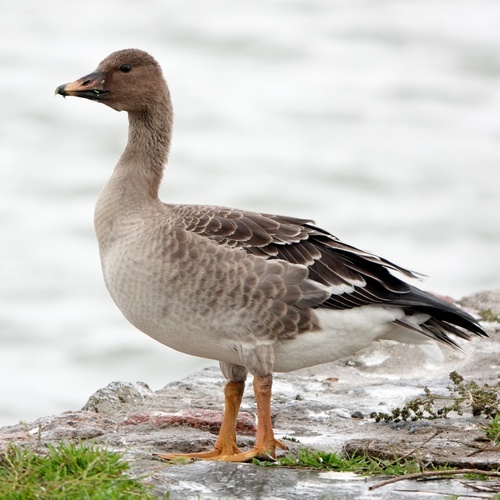
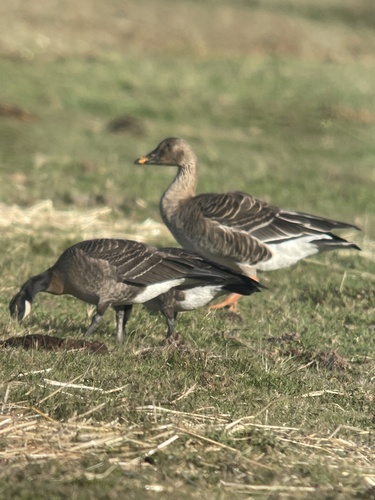
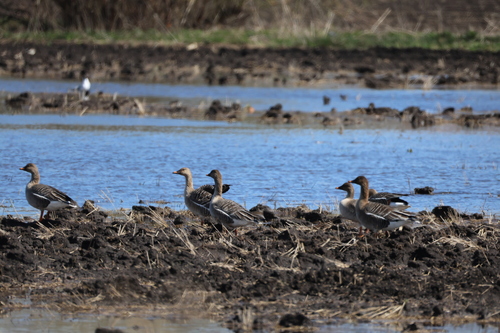
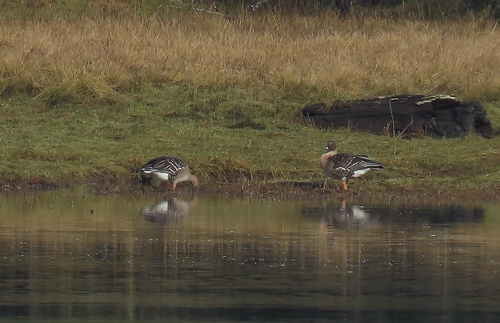
Anser fabalis (Latham, 1787)
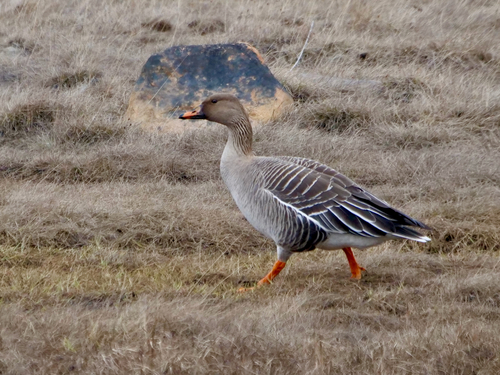
Source: Wikipedia
Synonyms 3
- 150,094 GBIF occurrences
- 4,617 iNaturalist observations
The European breeding population is estimated at 183,000-208,000 pairs (366,000-415,000 mature individuals) and the wintering population is estimated at 703,000-971,000 individuals (468,000-647,000 mature individuals). The breeding population in the EU28 is estimated at 1,200-3,100 pairs (2,500-6,200 mature individuals), and in wintering population is estimated at 703,000-970,000 individuals (468,000-647,000 mature individuals). For details of national estimates, see the Supplementary Information.
The species breeds near lakes, pools, rivers and streams in high Arctic tundra or the taiga forest zone (Carboneras and Kirwan 2014). Taiga nesting populations show a preference for scrubby birch (Betula spp.) forest and dense spruce forest with bogs or mires (Madge and Burn 1988), whereas tundra-based populations nest on damp tundra of moss, grass, sedge or scrub (Johnsgard 1978) near river flood-plains (but above flood levels) on Arctic islands and in Arctic coastal regions (Madge and Burn 1988). During the winter and on passage the species inhabits marshes, agricultural land (Carboneras and Kirwan 2014), damp steppe grassland (Madge and Burn 1988), flood-lands, rivers and coastal shallows (Snow and Perrins 1998) in open country. It also roosts on lakes, rivers and flood-lands in Europe during this season. Populations that breed in the taiga nest in early-May, with those breeding in the tundra nesting one month later in early-June (Kear 2005). The species builds a nest of vegetation in a shallow scrape on the ground and clutch size is generally four to six eggs. The species is herbivorous, its diet consisting of herbs, grasses, sedges (Carboneras and Kirwan 2014) and mosses (Johnsgard 1978), complemented during the breeding season by berries. During the winter it feeds predominantly on agricultural land taking grain, beans, potatoes (Carboneras and Kirwan 2014) and sprouting winter cereal crops (Kear 2005). This species is strongly migratory and travels between breeding grounds in the high Arctic to wintering grounds in the temperate and subtropical zones (Carboneras and Kirwan 2014).Although the generation length for both EU and Europe regional assessments were calculated using the same methodology, new information arriving after the EU assessments were undertaken gave rise to an update in the generation lengths. This new information was then used for the Europe level assessments giving rise to a difference between the generation lengths used for the EU and Europe regions.
The species declined in the past due to hunting (resulting in mortality, injury and disturbance) (Kear 2005, Nikolaeva et al. 2006, Carboneras and Kirwan 2014) and habitat loss (Carboneras and Kirwan 2014). Habitat degradation due to oil pollution (Grishanov 2006, Nikolaeva et al. 2006), drainage, peat-extraction, changing management practices (decreased grazing and mowing in meadows leading to scrub over-growth) and forest clearance is a threat to breeding areas in Russia (Grishanov 2006), Norway and Sweden (Madge and Burn 1988). The species also suffers from human persecution (Madge and Burn 1988) and is susceptible to poisoning by pesticides used on agricultural land (Kwon et al. 2004). Climate change poses a potential threat longer term on breeding grounds, most likely particularly to tundra populations (Carboneras and Kirwan 2014).
Conservation Actions UnderwayEU Directives Annex II. CMS Appendix II. Bern Convention Appendix III. The species is listed on the African-Eurasian Migratory Waterbird Agreement. Compensatory payments are paid to farmers in the Netherlands; as a result research has been undertaked focusing on minimizing damage by altering land use in agricultural areas and restoring original habitats for wintering geese (Carboneras and Kirwan 2014). In many countries, counts of the species and monitoring are carried out each year. International protection of key wetland habitats for the species is provided by Special Protection Areas, Ramsar and the Bern Convention (Hearn 2004).Conservation Actions ProposedBetter quality and more widespread monitoring is needed for this species, particularly to assess the impact of hunting. A Flyway Management Plan is essential for international co-ordination of monitoring (Hearn 2004). More key sites should be protected and management and conservation needs should be integrated. Stricter regulation on hunting and persecution should be implemented.
European regional assessment: Least Concern (LC)EU28 regional assessment: Vulnerable (VU)In Europe, in winter, this species has an extremely large range (its extent of occurrence (EOO) is much larger than 20,000 km² and its area of occupancy (AOO) is much larger than 2,000 km²), and hence it does not approach the thresholds for Vulnerable under the range size criteria (criteria B and D2). The population size is very large, (much larger than 10,000 mature individuals), and hence it does not approach the thresholds for Vulnerable under the population size criteria (criteria C and D). The population trend appears to be increasing, and hence does not approach the thresholds for Vulnerable under the population size reduction criterion (criterion A). The probability of extinction has not been calculated for this species, therefore criterion E cannot be applied. For these reasons the species is evaluated as Least Concern in Europe.In the EU28, in the breeding season, this species has a very large range (its extent of occurrence (EOO) is much larger than 20,000 km² and its area of occupancy (AOO) is much larger than 2,000 km²), and hence it does not approach the thresholds for Vulnerable under the range size criteria (criteria B and D2). The probability of extinction has not been calculated for this species, therefore criterion E cannot be applied. Despite the fact that the population trend appears to be decreasing, the decline is not believed to be sufficiently rapid to approach the thresholds for Vulnerable under the population size trend criterion (criterion A). The population size is small, and, combined with the ongoing decline, meets the thresholds for Vulnerable (VU) under the population size criterion C and is therefore assessed as such in the EU28. There is not considered to be significant potential for rescue from outside the region, and therefore the final category remains unchanged.
Gallery