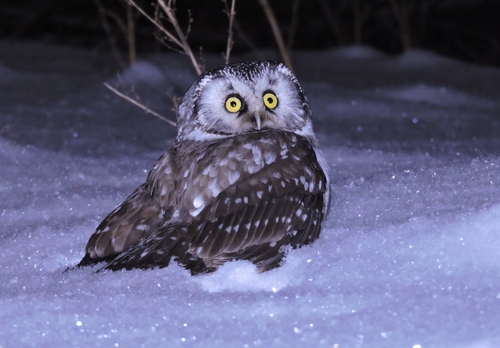
Aegolius funereus (Linnaeus, 1758)
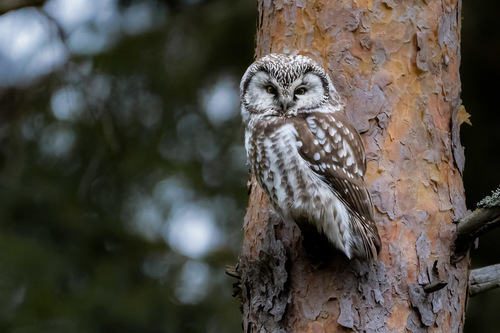
Source: Wikipedia
Synonyms 7
- 300,307 GBIF occurrences
- 2,107 iNaturalist observations
The total number of pairs for each country the species occurs in was taken from BirdLife International (2021) (2,919 to 7,078 pairs). Not all of the area of these countries occurs within the Mediterranean hotspot boundary, so the proportion of its range within these countries was calculation (c.10.3%). Therefore, the population size was reduced proportionally. This gives a population size of 599-1,454 mature individuals. Given that there is some uncertainty around this, a wider range is used here of 500-1,500 mature individuals. The overall population trend in the Mediterranean region is unknown.
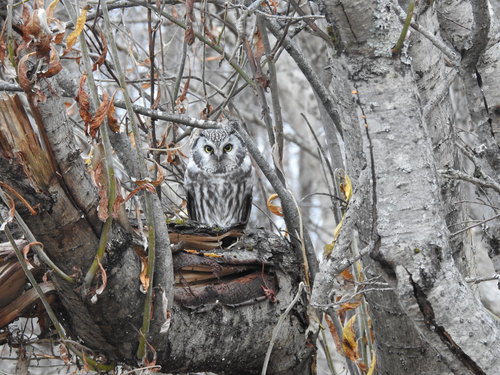
The species occupies coniferous forests, breeding mainly in spruce (Picea) forests but also uses mixed forests of pine (Pinus), birch (Betula) and aspen (Populus tremula) and even uses pure pine forests (Hagemeijer and Blair 1997). Breeding may begin in February, in good vole years (Mikkola 1983) and continue until July (Holt et al. 1999) but most eggs are laid in April. It nests in holes, such as disused woodpecker holes or where these are not available it will use nest boxes. No nest is made and eggs are laid directly onto debris, although if there is soft material in the hole it will make a shallow depression (Mikkola 1983). Clutches are usually three to seven eggs. It feeds principally on small voles as well as mice, shrews and small birds (Snow and Perrins 1998), but also recorded taking flying squirrels, bats, frogs and beetles (Mikkola 1983). This species is generally a year-round resident within a stable home range, but it disperses in years when prey is scarce (Holt et al. 1999).
The breeding population of this species fluctuates with vole cycles and the depth of annual snow cover, which inhibits foraging. Forestry can reduce primary prey populations, remove forest structure necessary for foraging, and eliminate nest cavities (Holt et al. 1999). At one time the species frequently used old Black Woodpecker (Dryocopus martius) holes but declines in the species has resulted in less nesting opportunities (Mikkola 1983). Tawny owls (Strix aluco) and martens (Martes spp.) are serious predators of this species and in some years the latter can destroy a high percentage of broods and kill many females on the nest. It is also vulnerable to pesticides (König et al. 2008).
Conservation Actions UnderwayCITES Appendix II. EU Birds Directive Annex I. Bern Convention Appendix II. Nest boxes have been employed extensively in Europe to help mitigate loss of nest-sites and to monitor demographic characteristics, for example by ringing nestlings; Around 11,000 boxes have been installed in Finland from which fledglings ringed annually (Holt et al. 1999).Conservation Actions ProposedCareful forestry management is required for this species. Selective harvesting may allow tree removal while maintaining suitable habitat for the species. In addition, because forest succession is slow in spruce-fir forest, practices must acknowledge that clear-felled sites will remain unsuitable for roosting or foraging for up to a century, and new nest trees will not develop for up to two centuries (Holt et al. 1999). The provision of nest boxes has proved effective and this practice should continue. Predation by martens can be reduced by placing a strip of metal or plastic c. 50 cm wide above and below nest holes and the use of ‘anti-marten’ boxes can be effective (König et al. 2008).
Mediterranean regional assessment: Vulnerable (VU)This species has a scattered range within the Mediterranean region. However, in part this is based on the region's distribution rather than the species'. For instance, there is a contiguous subpopulation found in the Alps but only the edges of this subpopulation overlap with the Mediterranean region. Based on population size figures for the countries this species occurs in within the Mediterranean region, and taking into account the proportion of this distribution that falls within the Mediterranean region, the population size is estimated here at 500-1,500 mature individuals. The population trend is unknown. While there is the potential for immigration from the surrounding subpopulations, this species is not migratory so it is uncertain whether there would be a significant immigration of individuals from outside of the Mediterranean hotspot. Therefore, no regional adjustment has been made and this species is assessed as Vulnerable under criterion D1.
Gallery