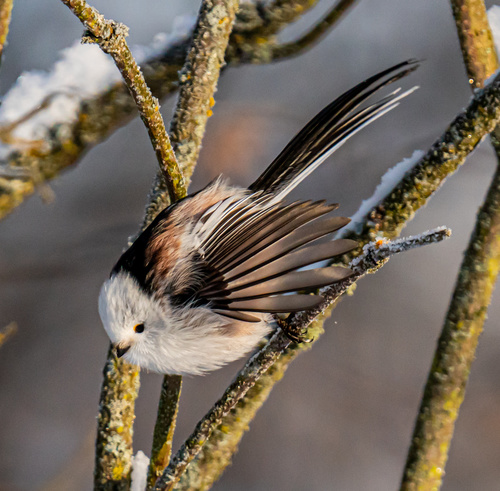
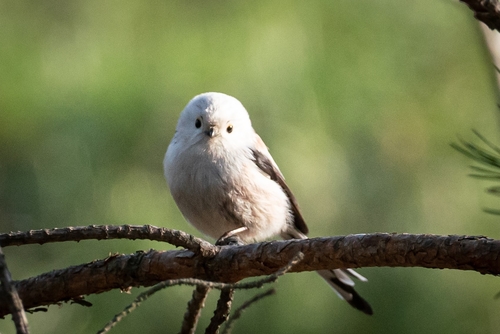
Aegithalos caudatus (Linnaeus, 1758)
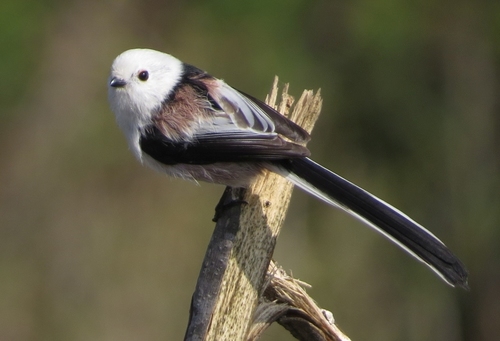
Source: Wikipedia
- 3,270,396 GBIF occurrences
- 80,530 iNaturalist observations
In Europe, the total population size is estimated at 16,300,000-29,200,000 mature individuals, with 8,190,000-14,600,000 breeding pairs (BirdLife International 2021), and comprises approximately 45% of the species' global range, so a very preliminary estimate of the global population size is between 36,200,000-64,900,000 mature individuals, although further validation of this estimate is desirable. In Europe, the species' population is considered to have remained relatively stable over three generations (10 years) (BirdLife International 2021). Based on these data, and the proportion of the species' global range that this region holds, the global population size is considered to be stable over three generations.
This species prefers deciduous and mixed woodland with a well-developed shrub layer, especially willows (Salix) and favouring edge habitats. It is also found in riverine woodland, scrub heathland with scattered trees, bushes and hedges in farmland and well-wooded suburban parks, cemeteries and gardens. In the Mediterranean it also uses maquis and open pine (Pinus) forest. Otherwise, avoids pure stands of conifers in west of range, but noted in open forests of spruce (Picea), fir (Abies), larch (Larix) and Siberian stone pine (Pinus sibirica) in central Siberia. It breeds from mid-March to June in Europe and Japan and from March onwards in Iran and March to April in north-east China. The nest is a compact, domed, oval ball of moss, cobweb and hair, covered with up to c. 3,000 flakes of lichen for camouflage and with an entrance hole at one side near the top. It is lined with small feathers and adults may continue to add feathers during laying period. It is usually found in a low thorny bush, but a few are built up in tree fork or against a trunk, or hanging among terminal twigs of conifer (Harrap 2008). Normally eight to twelve eggs are laid. It feeds mainly on arthropods although plant matter is taken occasionally during autumn and winter. The species is resident in temperate and Mediterranean areas, but irruptive movements occur farther north (Snow and Perrins 1998).
Declines in Sweden and Finland are likely as a result of modern forestry practices and the replacement of old-growth habitats with commercial monocultures. During the winter flocks require large territories and habitat fragmentation and degradation can thus threaten local populations. It is vulnerable to severe winters, which can cause numbers to decline by up to 80% and it can take years for populations to recover. Reproductive success can be suppressed by predation of nests, most commonly by crows (Corvidae), weasels (Mustela) and snakes (Harrap 2008).
Conservation Actions UnderwayThere are currently no known conservation measures for this species in Europe.Conservation Actions ProposedA wide-scale approach to the preservation of suitable habitat for this species is important. Increasing the amount of old deciduous forests close to existing habitats has been shown to be an effective strategy for this species (Lindbladh et al. 2011). In some areas predator control may be appropriate and research should investigate the effectiveness of this in increasing populations.
This species has an extremely large range and the population size is extremely large, hence does not approach threatened thresholds for the range or population size criteria. The population trend appears to be stable, and hence the species does not approach the thresholds for Vulnerable under the population trend criterion. For these reasons the species is evaluated as Least Concern.
Gallery