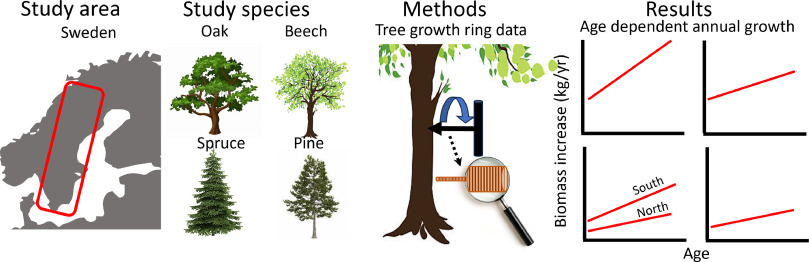
A new study by researchers from Linnaeus University and collaborators examines how tree age, latitude, and species identity shape biomass accumulation in Sweden's forests. By combining tree-ring data with biometric modeling, the team sheds new light on how growth trajectories respond to climate change and vary across species' range margins — with implications for forestry, biodiversity conservation, and climate mitigation strategies.
Key Findings
- Biomass increment stays positive across the lifespan. On average, trees continued to accumulate biomass at increasing rates with age, across species, individuals, and latitudes — including at Sweden's northern range margins.
- Deciduous species outpace evergreens. Oaks (Quercus spp.) and European beech (Fagus sylvatica) showed higher age-specific growth rates than the evergreen conifers Norway spruce (Picea abies) and Scots pine (Pinus sylvestris).
- Growth declines with latitude. Within each species, age-specific biomass increment fell as latitude increased, reflecting the more challenging growing conditions toward the northern limits of these species' ranges.
- A warming signature in recent growth. For spruce and beech, biomass increment rose significantly with germination year — a pattern the authors suggest may reflect faster growth in more recently established trees, consistent with a warmer climate and longer growing seasons.
The researchers used dendrochronological methods to generate 26,225 estimates of annual biomass increment from 136 individual trees, spanning two evergreen conifers (spruce and pine) and two deciduous broadleaf species (oak and beech). The dataset includes remarkably old individuals — ranging from 150 to over 400 years old — sampled from sites spanning more than 10° of latitude (55.0–66.3°N) across Sweden.
Implications for Conservation and Forestry
The findings reinforce the ecological and climatic value of old-growth trees: far from slowing down, older trees kept adding biomass at increasing rates, underscoring their outsized role in long-term carbon storage and biodiversity support. As climate change continues to alter forest growth dynamics, understanding how growth varies by species, age, and latitude will be essential for designing forestry practices and conservation strategies that balance productivity, biodiversity, and climate goals.
Forsman, A., Isaksson, J., Franzén, M., & Edvardsson, J. (2024). Variable associations of annual biomass increment with age, latitude and germination year in four tree species in Sweden. Trees, Forests and People, 18, 100733. https://doi.org/10.1016/j.tfp.2024.100733